
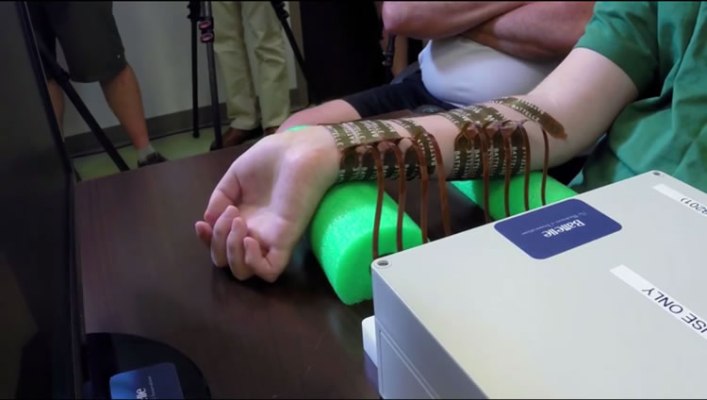
For the first time in history a man is capable of moving his hand and fingers by his thoughts via a new type of neurological technology. Engineers from Battelle and Ohio State University doctors created a device that bypass the Spinal Cord and allows the brain to directly connect neural brain signals to specific limbs for movement. The study was conducted using 23 year old Ian Burkhart, a quadriplegic and native of Dublin, Ohio.
[Neuroscience News Excerpt]
–“It’s much like a heart bypass, but instead of bypassing blood, we’re actually bypassing electrical signals,” said Chad Bouton, research leader at Battelle. “We’re taking those signals from the brain, going around the injury, and actually going directly to the muscles.”
The Neurobridge technology combines algorithms that learn and decode the user’s brain activity and a high-definition muscle stimulation sleeve that translates neural impulses from the brain and transmits new signals to the paralyzed limb. In this case, Ian’s brain signals bypass his injured spinal cord and move his hand, hence the name Neurobridge.
Burkhart, who was paralyzed four years ago during a diving accident, viewed the opportunity to participate in the six-month, FDA-approved clinical trial at Ohio State’s Wexner Medical Center as a chance to help others with spinal cord injuries.
Initially, it piqued my interested because I like science, and it’s pretty interesting,” Burkhart said. “I’ve realized, ‘You know what? This is the way it is. You’re going to have to make the best out of it.’ You can sit and complain about it, but that’s not going to help you at all. So, you might as well work hard, do what you can and keep going on with life.”
This technology has been a long time in the making. Working on the internally-funded project for nearly a decade to develop the algorithms, software and stimulation sleeve, Battelle scientists first recorded neural impulses from an electrode array implanted in a paralyzed person’s brain. They used that data to illustrate the device’s effect on the patient and prove the concept.
Two years ago, Bouton and his team began collaborating with Ohio State neuroscience researchers and clinicians Dr. Ali Rezai and Dr. Jerry Mysiw to design the clinical trials and validate the feasibility of using the Neurobridge technology in patients.”–
 Product Of Society