

Israel-Gaza Conflict
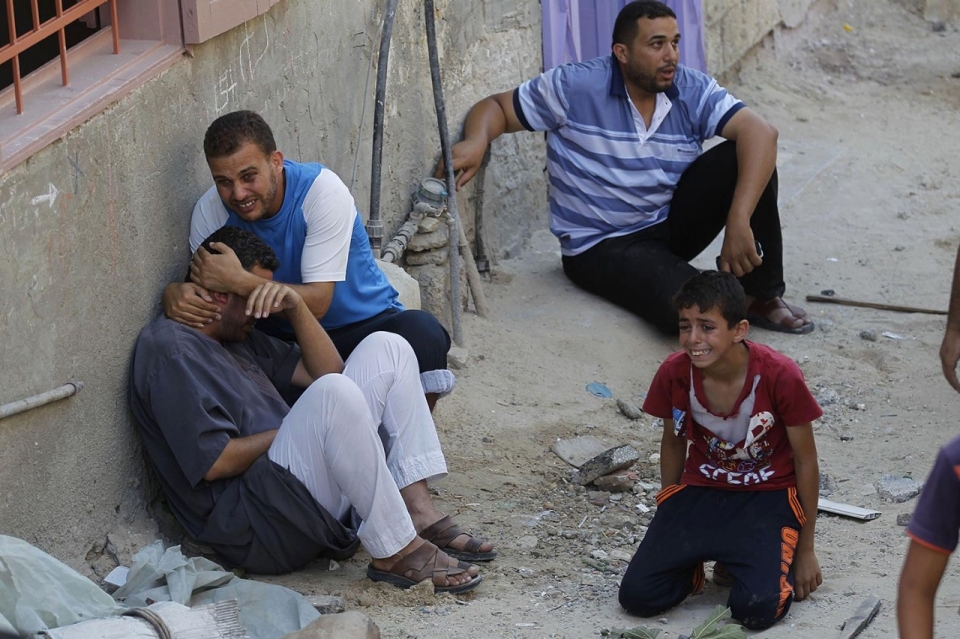
Two weeks ago, the killing of 4 young boys on a Gaza beach caught international attention. The boys were playing, as they had done times before, when an Israeli rocket landed on the Mediterranean shore. This incident is one of many that illustrate the disproportionate and growing civilian death toll on the Gaza Strip.
Presently, nearly 1,200 Palestinians have been killed, 75 percent of those being civilians. Compared to Israel’s lost of 53 soldiers and 3 civilians.
The Gaza Strip
The Gaza Strip is a Palestinian region located on the eastern coast of the Mediterranean Sea. Gaza borders Egypt to the southwest and Israel to the north and east. The region is about twice the geographical size and population of Washington, D.C.
Hamas, deemed a terrorist organization by Israel and the U.S., was elected to government in 2006. The military wing of Hamas, The Izz ad-Din al-Qassam Brigades, is informed by the Hamas Covenant, the organization’s 1988 founding document, which includes a commitment to “fight Jews and kill them”. Militants have since then proceeded to launch attacks on Israel, against both civilian and military targets.
Since Hamas gained control of Gaza, Egypt closed 1,600 tunnels connecting Egypt to Gaza. Egypt reports increased attacks by Hamas on Israel as well as in their own country as the reason for closings. Moreover, Israel ceased to allow pedestrian and cargo traffic across the Israel-Gaza barrier, strangling the area further. The tunnel closings hurt the economy of Gaza further, which now suffers unemployment rates upwards of 40%.
How did the fighting begin?
The violent election of Hamas in 2006 is a good starting point.
Short of understanding the entrenched religious and political tensions of the Middle East that contextualize all warfare in the area, the recent Israeli-Palestinian conflict can be traced to the abduction of an Israeli Corporal.
The catalyst sparked air and ground offensives from both sides, culminating with a one-month Gaza War, or Operation “Cast Lead”, in late 2008. An estimated 1,166-1,417 Palestinians and 13 Israelis died in the conflict.
2014 Conflict
On July 8 of this year, Israel’s Operation Protective Edge was initiated with the goal of stopping incessant rocket attacks from Hamas. After 8 days of initial airstrikes, Israeli Defense Forces escalated the Operation into a full ground offensive to crush Hamas’s terrorist infrastructure. The Operation is expected to cost 2.5 billion USD.
The militant wing of Hamas is integrated into everyday life on the Gaza Strip, making it difficult to distinguish soldiers from civilians. That confusion is what Israel claims is a military tactic of using “human shields”, which is the deliberate placement of non-combatants in or around combat targets to deter the enemy from attacking these targets. This is an international war crime and Israel’s explanation of the lopsided death tolls.
Peace efforts materialized as two U.N. humanitarian ceasefires. A 5-hour ceasefire was observed on July 17, followed by a 12-hour ceasefire on July 26. Nevertheless, the 2014 conflict is ongoing, and already the deadliest combat since the Gaza War of 2008.
Disproportionate Impact on Gaza
The conflict burdens the Palestinian region on multiple fronts. Hospitals are overcrowded and underequipped to deliver proper treatment to wounded civilians. Food prices have risen dramatically. All schools and universities are closed. Over 215,000 Palestinians have been displaced. Approximately 3,695 housing units have been destroyed or severely damaged rendering them uninhabitable, and 80% of people receive only 4 hours of electricity per day.
Israel and Hamas, the political party that controls Gaza, are at war, and this is what war looks like.
How do you feel about the current crisis? Should other other countries intervene to help diffuse this growing situation?
– Deanna H.
 Product Of Society