

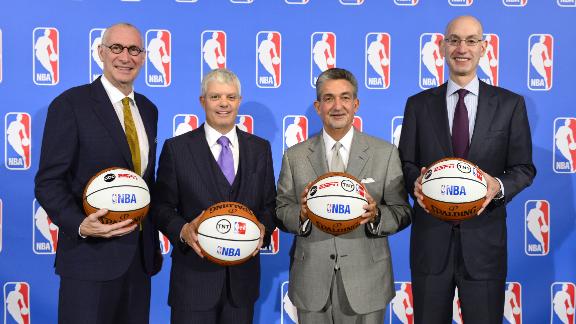
 Late Sunday night the NBA announced that it had struck a new deal with both Disney (Espn/ABC) and Turner (TNT/TBS) to continue their exclusive TV broadcasting rights. The current deal, which is worth $930 million per season, and set to be completed after the 2015-2016 season. Many of the leagues superstars and front office executives have seen this tremendous growth on the horizon once again and have prepared in strategic ways.
Fast forward to October 5th, 2014 when the NBA announced that it would renew its partnerships at an unprecedented $2.7 billion over nine seasons. This sent shockwaves throughout the NBA community and has started the conversation about the expanding salary cap and threat of a lockout. The NBA players association has the ability to opt out of the current CBA after the ’16-’17 season (which would be surprising if they do not) and restructure a deal that is much more player friendly.
Many wondered why over the summer LeBron James chose to sign a short term 2 year $48 million contract with his beloved Cavaliers, while fellow superstars Carmelo Anthony and Chris Bosh chose to sign longer 5 year deals, both worth at least $124 million.
Well, a look at the numbers will show that financially LeBron made a more business savvy decision. Over the course of the last 5 years the salary cap remained flat at $58 million before jumping to $63 million prior to this season. Over the next 3-5 seasons, it is inevitable that the salary cap would take another gigantic jump to reflect the growth of BRI (basketball related income), which has been agreed to be split 50-50 between the owners and players.
A jump from $930 million to $2.7 billion would certainly rocket the salary cap upwards but many league executives and salary cap experts expect there to be some “smoothing” to occur. Essentially, instead of one record breaking jump in the cap, the NBA and its partners would structure the payout in such a way that would gradually raise the cap over the life of the new TV rights deal, though a fair amount of greed comes into play with owners, who may find the prospect of slowing that cash flow to be a hard pill to swallow. All things considered, it is not crazy to expect the $63 million cap to balloon to $75-80 million in the next 3-7 years.
Flexibility in the structuring of a contract for mega stars like LeBron James is essential, teams locking in longer term contracts protect themselves from having to shell out $5-7 million dollars more per year. Which can be the difference in the hyper competitive free agency world we live in. Furthermore, contracts like Chandler Parsons (3 yr. $46 million) and Gordon Hayward’s (4 yr. $63 million) won’t look so out of place once the cap jumps by the value it is expected to.
Many teams like the: Lakers, Celtics and 76ers have planned to free up enormous cap space over the next 3 summers, in anticipation of the rising cap and possibility of signing multiple superstars at max-level type deals. Kevin Durant being the most notable of these superstars.
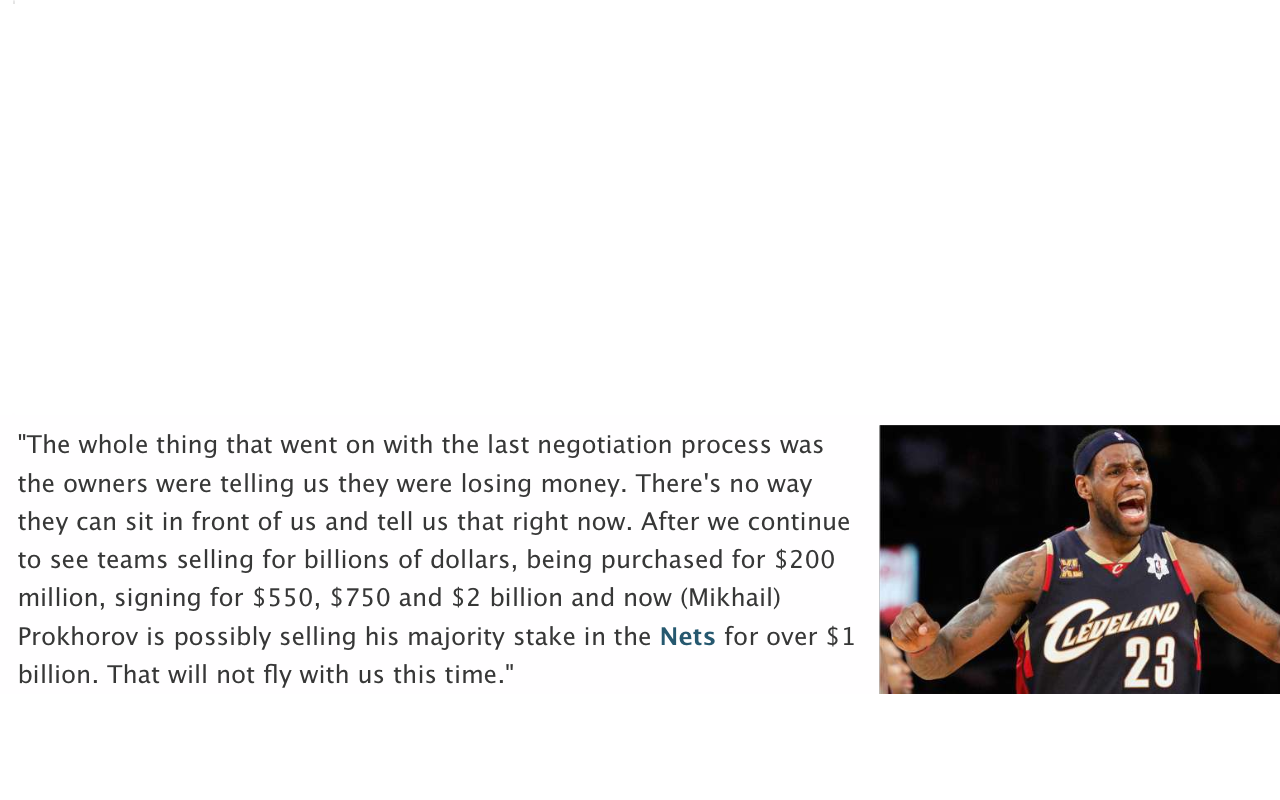
It will be interesting to see how free agency and the impending 2017 labor negotiations will unfold, as it is becoming more and more clear to players that there is an ever-expanding pie that they are interested in gaining a bigger slice of. See LeBron’s comments below.
–JB
 Product Of Society